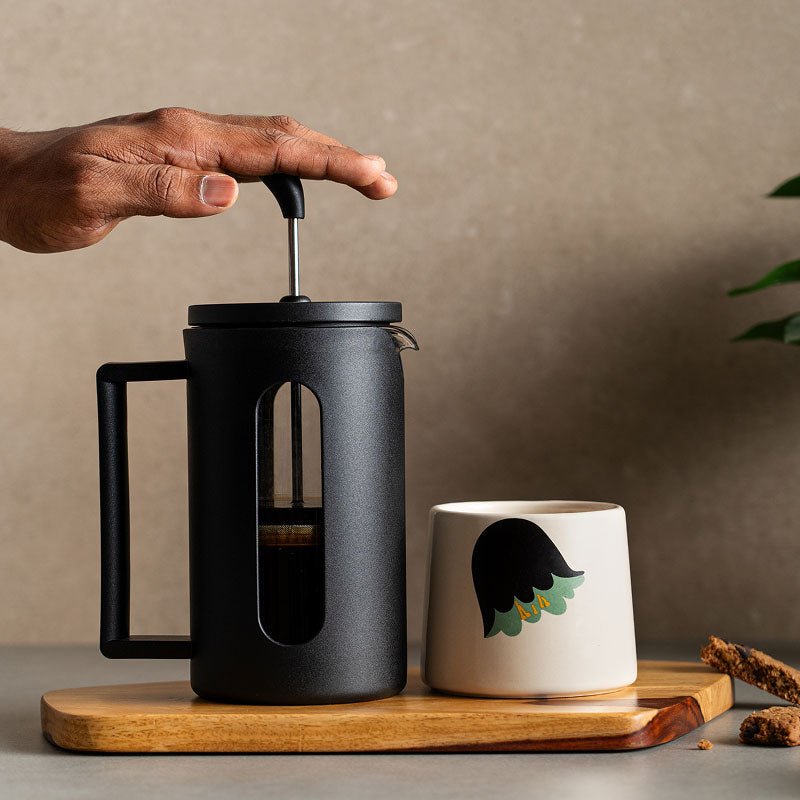
The difference is how far along the brewing process your coffee already is when you buy it. Instant coffee has been brewed and dried for you. Pre ground coffee has been ground for you but not brewed. Freshly ground coffee is whole beans you grind yourself, moments before brewing.
Every practical difference between the three, taste, aroma, shelf life, effort and cost, comes out of that one distinction. The further along the process your coffee arrives, the less work you do and the less flavour survives.
Instant, pre ground and freshly ground at a glance
|
Instant coffee |
Pre ground coffee |
Freshly ground coffee |
|
|
What you buy |
Dried coffee extract |
Ground coffee in a sealed bag |
Whole roasted beans |
|
Equipment needed |
A kettle |
A brewer |
A grinder and a brewer |
|
Time to a cup |
Under a minute |
3 to 5 minutes |
5 to 7 minutes |
|
Cleaning after |
Rinse a cup |
Brewer needs washing |
Brewer and grinder both |
|
Shelf life |
Years, though flavour fades |
3 to 6 months sealed |
Best within 4 weeks of roast |
|
Aroma |
Faint |
Moderate, fades fast once opened |
Strongest, released at grinding |
|
Control over the cup |
None |
Grind is fixed, ratio is yours |
Full control over grind and ratio |
|
Best for |
Travel, offices, emergencies |
Beginners and busy mornings |
Anyone who cares how the cup tastes |
What is instant coffee and how is it made
Instant coffee is real coffee that has already been brewed, then dried into granules or powder that dissolve in water. Nothing needs extracting when you make it, which is why it takes seconds.
The beans are roasted, ground and brewed at scale, then the liquid is dried until only the soluble solids remain. Freeze drying holds more of the aroma because it works at low temperatures. Spray drying is cheaper and pushes the extract through hot air, which costs more of the delicate compounds.
Its real advantage is that it asks nothing of you. A cup, hot water or milk, and you are done. No technique to learn, no ratio to weigh, and nothing to disassemble and wash afterwards, which matters more than people admit when they are running late or making coffee at a desk.
One myth worth correcting. Most instant coffee contains no added preservatives. It keeps for years because almost all the moisture has been removed, and bacteria cannot grow without water. The flavour loss comes from the drying itself and from the fact that the coffee was brewed weeks or months before it reached your cup.
If it is speed you want rather than the instant format itself, coffee pods and drip bags both deliver a properly brewed cup in about the same time, without the flat, cooked note that dried extract carries.
What is pre ground coffee and how long does it stay fresh
Pre ground coffee is whole roasted beans ground at the roastery and sealed into a bag. You brew it yourself, so you control the ratio, water temperature and brew time, but the grind size was decided before you bought it. A sealed bag holds up for three to six months, and once opened, most of the aroma is gone within about two weeks.
Almost any brewer works with it, and it does not have to be expensive. A French press, a Moka pot or an Aeropress all handle pre ground coffee well, while an espresso machine gives you cafe style drinks at home. Budget a few minutes a day for brewing and for cleaning the equipment afterwards. If you are choosing your first one, browse the manual brewers range and match the brewer to the grind you can buy locally.
The fixed grind is the real limitation, because one grind cannot suit every method. A bag labelled for filter is too fine for a French press and too coarse for espresso, so whichever brewer you own, you are working slightly outside the ideal.
Where pre ground clearly beats instant is in the oils. Coffee oils carry a large share of the flavour, and ground coffee holds onto them far better than dried extract does, which is why a pre ground brew tastes fuller and shows distinct flavour notes rather than one flat coffee taste.
Storage matters more than people think. Grinding multiplies the surface area of the coffee, which is what makes extraction possible and also what exposes it to oxygen. Ground coffee absorbs whatever it sits beside, so keep it somewhere cool, dark and dry, away from spices and anything strongly scented.
What is freshly ground coffee and is it worth the effort
Freshly ground coffee means grinding whole beans immediately before brewing, so the aromatic compounds released at the moment of grinding end up in your cup rather than in the air of a warehouse. It is worth it, and the reason is freshness rather than better beans.
Whole beans keep their flavour roughly three times longer than ground coffee, because the interior of the bean stays sealed off from oxygen until you break it open. They also pick up far fewer odours in storage, since there is very little exposed surface for smells to settle on.
The cost is three steps instead of one. Measure the beans, grind them to suit your brewer, then brew as usual. An electric burr grinder takes under a minute and a hand grinder takes two to four, so a coffee grinder is the single upgrade that improves a cup more than any other, more than a better brewer and more than better water.
Grinding at home also gives you the control pre ground denies you. Coarse for French press and cold brew, medium for filter and pour over, fine for espresso and Moka pot, all from one bag of beans. If you brew more than one way, this alone justifies the grinder.
Which tastes better, instant, pre ground or freshly ground
Freshly ground tastes best, pre ground sits in the middle, and instant is the weakest of the three. The gap shows up in aroma rather than in strength, because most of what we register as coffee flavour is actually smell.
Instant vs pre ground coffee
Pre ground wins on taste, instant wins on convenience. Instant has already been brewed and dried, so the aromatics were driven off long before the jar reached you. Pre ground is unbrewed, retains its oils, and gives you control over ratio and water temperature. Instant needs a kettle. Pre ground needs a brewer and the few minutes that come with it.
Pre ground vs freshly ground coffee
Freshly ground wins clearly. Volatile aromatic compounds start escaping the second coffee is ground and keep escaping in storage. By the time an opened bag of pre ground has sat on a shelf for a fortnight, a good share of them are gone. Grinding at home keeps them in the cup.
Instant vs freshly ground coffee
These sit at opposite ends of the same scale, so the choice is about priorities. Instant gives you a drink in forty seconds with nothing to clean. Freshly ground gives you the fruit, chocolate or floral notes the roaster intended, at the cost of a grinder and a minute of your morning.
Strength is a separate question and often confused with quality. You can make a strong cup from any of the three by using more coffee. What you cannot do is put aroma back once it has left.
Is brewing coffee at home cheaper than buying it
Yes, substantially. A cup brewed at home costs a fraction of the same drink bought out, and the gap widens fast when coffee is a daily habit rather than an occasional treat.
What keeps most people home brewing, though, is the process itself. Measuring the beans, hearing the grinder, watching the bloom rise in the press, waiting the four minutes. It is a slow, quiet few minutes at the start of a day that usually has very few of them.
There is a practical side to that too. Doing each step yourself means you understand what went into the cup, so when a brew comes out bitter or thin you know which variable to change. Instant gives you a drink. Brewing gives you a drink and the ability to make the next one better.
Which type of coffee should you buy
Choose based on how much friction you will tolerate on a weekday morning, not on which one is theoretically best.
Buy instant if
You need coffee at a desk, on a trek or in a hotel room with nothing but a kettle. It exists for convenience and it does that job honestly.
Buy pre ground if
You own a brewer but not a grinder, and you buy small bags often enough to finish them inside two or three weeks. It is a genuine step up from instant for very little extra effort.
Buy freshly ground if
You care how the cup tastes and will add sixty seconds to your routine. Start with a bag of whole bean coffee and a hand grinder, then upgrade the grinder later once you know your preferences.
None of this is a one way door. Plenty of people keep a jar of instant for travel and grind fresh at home, which is a perfectly sensible arrangement. If you are still working out the basics of ratio, grind and water, the guide to the four fundamentals of brewing coffee at home is the natural next read.