Skip to content

Free Delivery       |

7-Day Return Policy       |

Machine Maintenance Provided       |

Collection: Commercial Coffee Machine

Compare (0/5)

5 products

Budan Infinity Coffee Machine - Something's Brewing
Pre-Order

Budan Infinity Coffee Machine

Brand: Budan

Fully Automatic Machine

Regular price Rs. 66,999.00
Sale price Rs. 66,999.00 Regular price Rs. 99,999.00
Budan X7 Fully Automatic Coffee Machine - Something's Brewing
New Arrivals

Budan X7 Fully Automatic Coffee Machine

Brand: Budan

Fully Automatic Machine

Regular price Rs. 76,599.00
Sale price Rs. 76,599.00 Regular price Rs. 109,999.00
La Marzocco Linea Mini R Espresso Machine - Something's Brewing
Pre-Order

La Marzocco Linea Mini R Espresso Machine

Brand: La Marzocco

Semi Automatic Machine

Regular price Rs. 570,000.00
Sale price Rs. 570,000.00 Regular price Rs. 599,999.00
Xbloom Studio Precision Coffee Maker - Something's Brewing
Pre-Order

Xbloom Studio Precision Coffee Maker

Brand: Xbloom

Fully Automatic Machine

Regular price Rs. 109,899.00
Sale price Rs. 109,899.00 Regular price
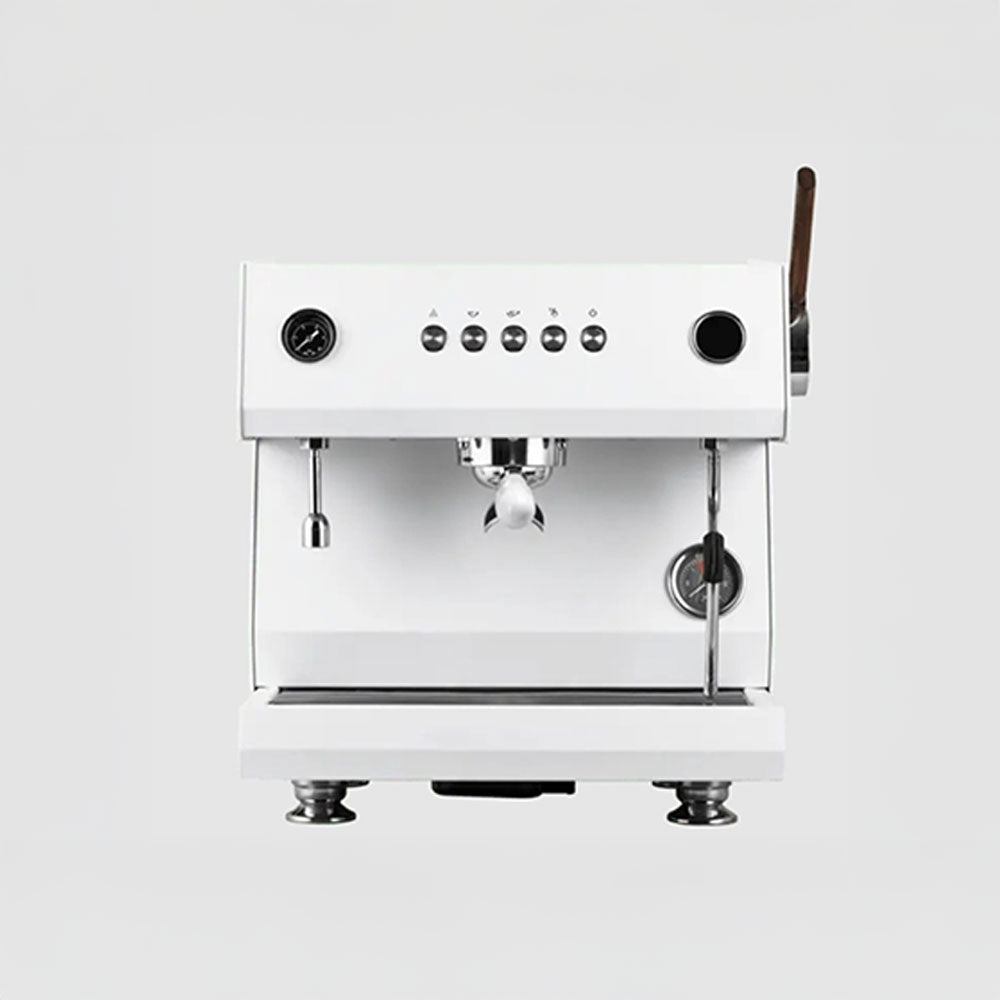
Budan Maestro - Something's Brewing

Budan Maestro

Brand: Budan

Semi Automatic Machine

Regular price Rs. 179,999.00
Sale price Rs. 179,999.00 Regular price Rs. 199,999.00

The Ultimate Guide to Commercial Coffee Machines – Somethings Brewing

Commercial Coffee Machines for Cafes, Offices and Businesses

A commercial coffee machine is built for a very different job than a home machine. It has to pull shot after shot through a morning rush without the boiler running out of steam, survive being cleaned by a different person every shift, and keep the same cup quality from the first order to the last. That is why a commercial espresso machine is heavier, better insulated and far easier to service than anything designed for a kitchen counter.

This collection brings together the commercial coffee machines we supply to cafes, restaurants, offices, co-working spaces, hotels and catering teams across India, from a compact espresso machine sized for a small business to fully automatic models that handle a few hundred cups a day at the touch of one button.

Why Choose a Commercial Coffee Machine for Your Business?

Consistency is the real reason businesses move up to commercial equipment. A commercial coffee machine holds brew temperature within a narrow band shot after shot, so the espresso your customer gets at 9am tastes like the one at 5pm. Domestic machines are not built for that duty cycle, and the drop in quality shows up in the cup long before anything actually breaks.

The second reason is throughput. A larger boiler and a proper heat exchanger recover steam pressure quickly, which means you are not waiting between cappuccinos while a queue builds. The third is serviceability: commercial machines use standard 58mm group heads, standard gaskets and standard screens, so a worn part is a routine replacement rather than a write-off.

For offices and smaller teams, our office coffee machines collection covers the lower-volume end of the same idea, where the priority shifts from speed to simplicity and minimal staff training.

Commercial Espresso Machines: Semi-Automatic vs Fully Automatic

Almost every commercial coffee machine falls into one of two camps, and the right one depends on who is going to operate it.

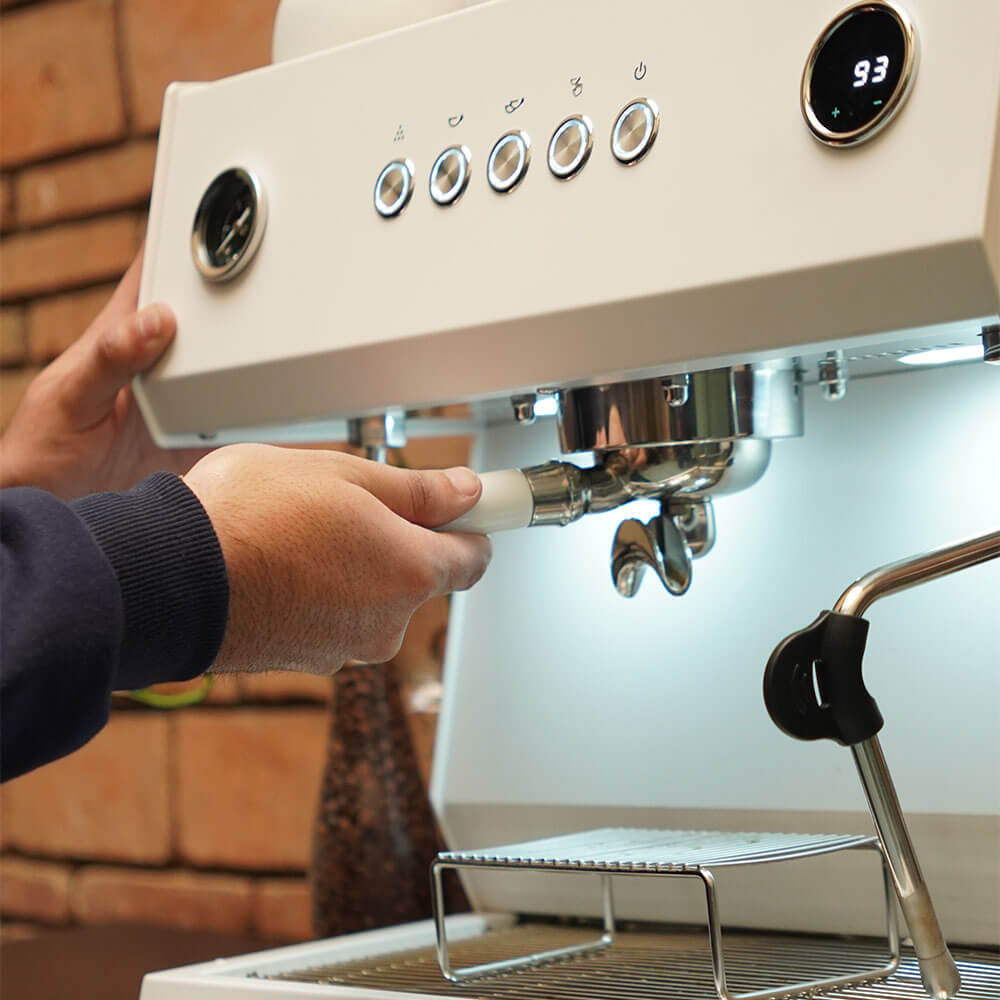
Semi-automatic machines put the barista in control. The operator doses, tamps, starts the shot and steams the milk by hand. This is what cafes and specialty-focused restaurants choose, because it allows dialling in a specific coffee and adjusting through the day as the beans change. Our semi-automatic espresso machines range covers single-boiler, heat-exchanger and dual-boiler builds.

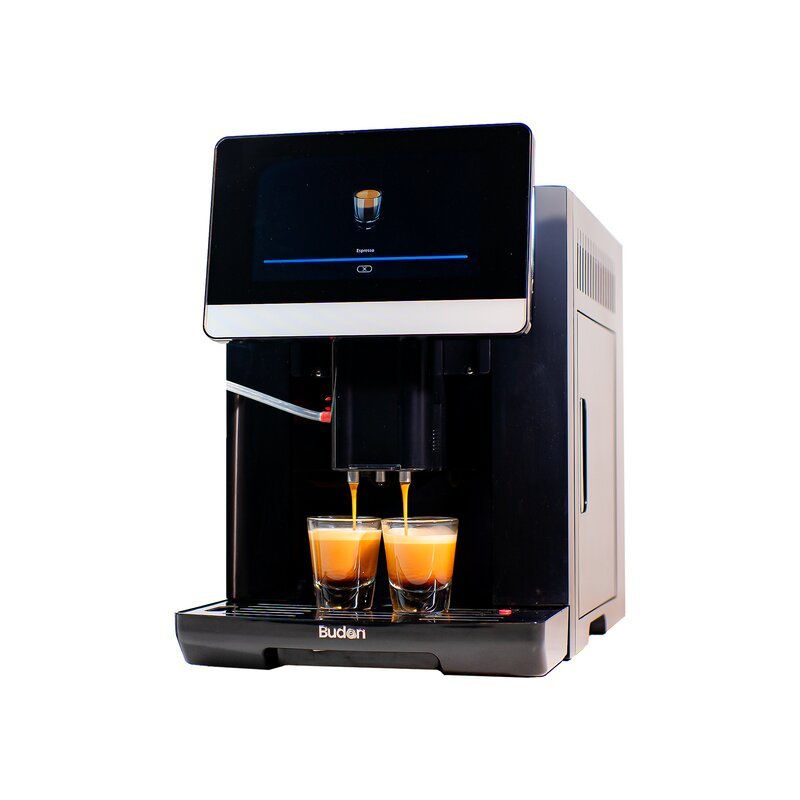
Fully automatic coffee machines grind, dose, brew and texture milk from a single press. They are the right answer for offices, hotel breakfast service, hospitals, showrooms and any site where the person making coffee is not a trained barista. The Budan X7 and Budan X1 in this collection sit in that category, and our automatic coffee machines collection has the wider range.

Between the two sits the semi-automatic machine with programmed volumetric dosing, which gives you barista control over the shot but removes the guesswork for staff who are still learning.

What to Consider When Buying a Commercial Coffee Machine

Daily cup volume and group heads

Work out your busiest hour, not your daily total. A single-group machine comfortably handles a steady flow of around 40 to 60 cups a day. Past that, a two-group machine lets one barista extract and steam at the same time instead of queueing behind their own workflow. Catering and event service usually needs more group capacity than the headline cup count suggests, because the demand arrives in bursts.

Boiler type

Single-boiler machines brew and steam from the same vessel, so you alternate between the two. Heat-exchanger machines let you do both at once from one boiler, which is the layout most of the Lelit coffee machines use. Dual-boiler machines hold separate brew and steam temperatures independently, and that is what you want if milk drinks make up most of your menu. The difference shows up most clearly in a rush.

Grinder pairing

The grinder decides more about the cup than the machine does. A commercial espresso machine paired with an underpowered grinder will never produce a stable shot, because grind consistency and retention control the extraction. Budget for a proper commercial grinder with flat or large conical burrs and stepless adjustment, sized to the same volume as the machine.

Build and after-sales access

Check the chassis and panels, the boiler material, and whether consumable parts are available in India. A commercial machine is a five to ten year purchase, and the cost of ownership sits mostly in spare parts, service visits and keeping proper machine cleaning equipment on site rather than in the machine itself.

Matching the Machine to Your Business

A specialty cafe with a trained barista and a rotating single-origin menu wants a semi-automatic dual-boiler machine and a grinder it can adjust between batches. Our coffee machine for cafe collection is built around that setup.

A restaurant serving coffee after meals, where orders arrive in clusters at the end of a service, usually does better with a fully automatic machine behind the pass, or a two-group semi-automatic if there is a dedicated coffee station. Our restaurant coffee machines range covers both.

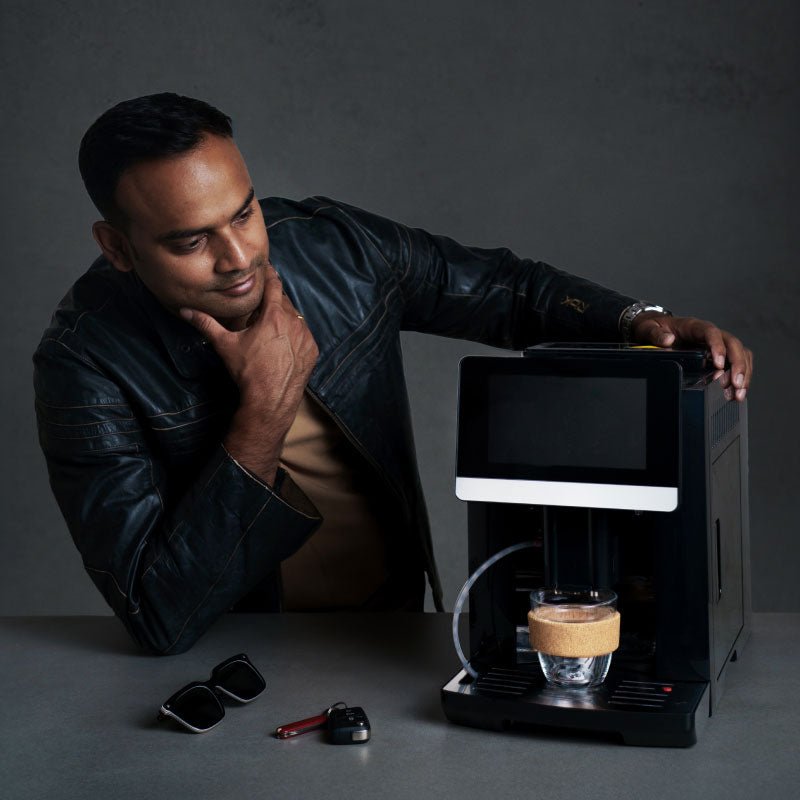
An office or co-working space wants a fully automatic coffee machine with a milk system, because nobody on the floor is going to tamp a basket. Low intervention matters more than control.

A hotel or banquet operation needs volume and recovery above everything, plus a machine that several different staff can run the same way.

A catering or mobile setup needs to think about power availability and water supply first, then choose the machine that fits those limits.

Whatever the setting, the machine is only part of the result. Fresh coffee beans roasted for espresso will change your cup more than moving one tier up in machine price.

The same goes for the small things. A scale, a tamper and a knock box from our barista tools range, used consistently, are what turn a good machine into a reliable one.

Why Buy Your Commercial Coffee Machine from Something's Brewing?

We sell commercial coffee machines as equipment, not as boxes. That means we will ask about your cup volume, your menu, your water, your power point and your counter depth before recommending anything, because a machine that does not fit the site is an expensive mistake.

We stock the brands we can actually support, we hold consumable spares, and we run service out of our Bangalore and Surat stores. Our team works with cafes, roasteries and offices every day, so the advice comes from installations rather than a spec sheet. If you are comparing two machines and cannot decide, talk to us before you order.

FAQ's

Does a commercial coffee machine need a water filter?
Yes, in almost every Indian city. Hard water scales a boiler from the inside, and scale is the single most common cause of commercial machine failure. A filter or softener sized to your water hardness and your volume costs a fraction of a boiler replacement, and it will usually be a condition of your warranty.
Can a commercial coffee machine run on a normal single-phase power point?
Smaller single-group machines generally can, on a dedicated circuit. Two-group machines and higher-output fully automatic machines often need a higher-rated single-phase supply or three-phase power. Confirm the electrical requirement before the machine arrives, because retrofitting a circuit after installation is slower and more expensive than planning for it.
How often should a commercial coffee machine be cleaned?
Far more often than a home machine. Group heads should be backflushed with detergent at the end of every service day, the shower screens and gaskets checked weekly, and the steam wand wiped and purged after every drink. Descaling frequency depends entirely on your water and volume rather than a fixed calendar, which is why filtration matters so much.
Is a commercial machine worth it for a small business or a low-volume cafe?
Often yes, for stability rather than speed. Even at modest volumes, a commercial build holds temperature better and lasts longer under multi-operator use. The question to ask is not how many cups you make but how many different people will make them, and how long you need the machine to last.
Can the same machine make espresso, cappuccino and latte?
Yes. Any commercial espresso machine with a steam wand covers the full milk-based menu, and fully automatic models with an integrated milk system will produce cappuccino and latte to a set recipe. What changes between machines is how many milk drinks you can make back to back before steam pressure drops.
Do you provide installation and service for commercial machines?
Yes. Commercial machines are installed rather than unboxed, and we handle setup, water connection guidance and staff orientation, with service support from our stores. Tell us your site details when you enquire so we can flag anything that needs sorting before delivery.
What is the difference between a commercial and a domestic coffee machine?