A coffee tamper is the cheapest piece of equipment that will change your espresso, and the one most people skip. The puck you compress in the basket decides how water moves through the coffee, and uneven pressure means water finds the easy path and runs through a channel instead of the whole bed. Everything you did before that point, the beans, the grind, the dose, is lost in that one channel.
This collection covers hand tampers, levelers, distributors and dosing funnels in 57mm and 58mm, from Budan and Lelit, alongside the rest of our barista tools range.
Why Tamping Decides Your Shot
Your espresso machine pushes water through the puck at around 9 bar at the group head. At that pressure, the coffee bed behaves like a filter, and a filter only works if it is uniformly dense. Compress one side harder than the other and water takes the softer route, pulling hard from part of the bed and barely touching the rest. The result is a shot that is sour and watery at the same time, which is why channelling is so hard to diagnose by taste alone.
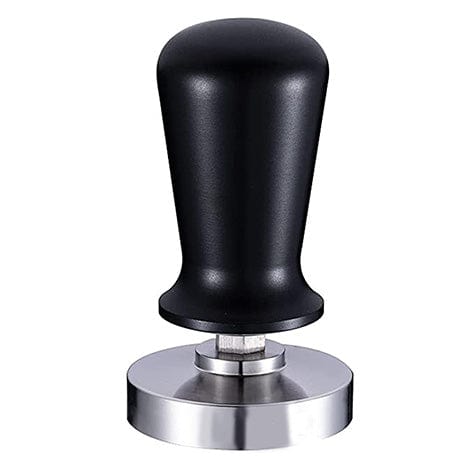
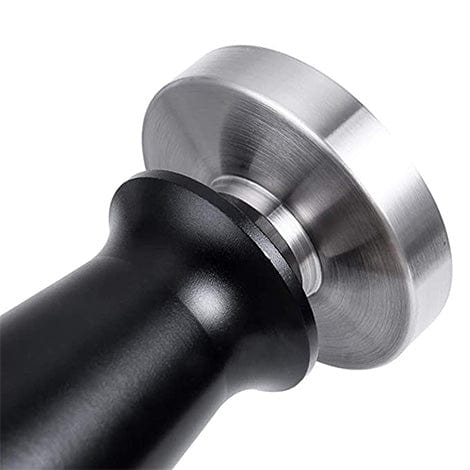
A proper tamper gives you two things a plastic machine-supplied tamper cannot: a base milled to actually fit your basket, so there is no rim of loose coffee left around the edge, and enough mass that you can tamp level without fighting the handle.
Tamper, Leveler or Distributor: What Does What
These three get used interchangeably, and they are not the same tool.
Tampers
A tamper compresses. It is the final step before the basket goes into the group, and its job is to leave a flat, evenly dense puck. Our guide to coffee tampers goes through the types in more detail.
Levelers and distributors
A leveler, sometimes sold as a distributor or an OCD tool, does not compress. It sits on the rim of the basket at a set depth and sweeps the grounds flat with a rotating blade before you tamp. If your grinder drops coffee in a mound, this is the tool that fixes it, and it is why the Budan 58mm Coffee Leveler and Distributor and the Lelit Coffee Leveler 57mm sell alongside tampers rather than instead of them.
Dosing funnels
A magnetic dosing funnel clips to the top of the basket and stops grounds spilling over the edge while you grind or distribute. On a busy bar it saves more coffee over a month than most people expect, and it makes levelling far easier because nothing is sitting on the rim.
Choosing the Right Size: 57mm, 58mm and 58.5mm
Tamper size is not a preference, it is a measurement, and getting it wrong is the most common mistake in this category.
Most commercial and prosumer machines use a 58mm basket, which takes a 58mm or 58.5mm tamper. The tighter 58.5mm fit leaves almost no gap at the edge, but it is less forgiving if your basket has any taper. Lelit machines are the notable exception at 57mm, which is why we stock the Lelit Coffee Tamper 57mm and Lelit Coffee Leveler 57mm separately. Compact home machines such as the De'Longhi Dedica use 51mm.
Measure the inside diameter of your own basket before ordering rather than going by the machine's advertised group size. A tamper 1mm too small leaves a ring of uncompressed coffee that water will exploit every time.
Flat, Convex or Ripple Base
A flat base is the standard and the right default. It produces a level puck surface and pairs predictably with a leveler.
A convex base is slightly domed, which compresses the centre marginally more than the edges. Some baristas prefer it on machines where water distribution favours the middle of the shower screen, and it can help if you are fighting edge channelling. It is a correction, not an upgrade.
Ripple and spiral bases push coffee outward as they turn, which some people use in place of a separate distribution step. If you are pulling shots through a bottomless basket from our portafilters range, you will see the difference between these bases immediately, because a bottomless basket shows you exactly where the shot is spraying.
Manual, Click and Electric Tampers
A standard hand tamper gives you full control and costs the least, and with a consistent routine it is all most setups need. The limitation is you, not the tool: holding the same force for every shot across a shift is harder than it sounds, and our tamping guide covers how to build that consistency.
A click or calibrated tamper solves that with a spring that clicks at a set force, usually around 15kg. It removes force variation between operators, which matters most in a cafe where several people make coffee. The Budan 58mm Click Tamper in this collection is that style.
Electric and automatic tampers go a step further, holding both force and depth identically every time, and they are built for high-volume bars where a few hundred shots a day make the repeatability worth the cost and the counter space. For home and small cafe use, a click tamper gets you most of the benefit.
Building a Complete Tamping Setup
A tamper on its own is an improvement. A tamper paired with the rest of the dosing chain is a different level of consistency.
Start with a scale. Tamping consistently is pointless if your dose varies by half a gram between shots, so a coffee scale that reads to 0.1g is the first thing to add.
Then look at the grinder, because distribution problems usually start there. A grinder that clumps forces you to work harder at levelling, while a clean espresso grinder drops coffee loosely and evenly into the basket and makes the tamp almost automatic.
Finally, keep the hardware clean. Coffee oils build up on tamper bases and leveler blades and go rancid, and that taste carries straight into the cup, so a brush and the right cleaning products belong in the same drawer as the tamper.
Buy Coffee Tampers and Levelers from Something's Brewing
We sell tampers as part of a brewing setup rather than as a loose accessory, which means we will ask what machine and basket you are running before recommending a size. Get that one detail right and the tool works for the life of the machine.
If you would rather handle a tamper before buying it, our Bangalore and Surat stores carry the range, and you can find both on our store locator. Weight, handle shape and balance are personal, and ten seconds in the hand tells you more than any spec.