Is It Okay to Drink Coffee at Night? How to Enjoy an Evening Cup Without Losing Sleep
Drinking coffee at night is fine for your health but costly for your sleep. Caffeine has a half life of five to six hours, so a cup at 9 pm still has half its caffeine working in your system at around 2 am. For most people the practical cutoff is six to eight hours before bed, which means stopping somewhere between 2 pm and 4 pm if you sleep at 10 pm.
That does not rule out an evening cup. It changes what should be in it.
What caffeine actually does to your sleep
Caffeine does not work the way most people assume. It does not add energy, and it does not cancel tiredness. It interrupts a signal.
It blocks the signal, it does not clear the debt
Through the day your brain accumulates a compound called adenosine, and as it builds up it creates what sleep researchers call sleep pressure. That mounting tiredness you feel by evening is adenosine doing its job.
Caffeine blocks the receptors adenosine binds to. The adenosine itself keeps accumulating behind the blockade, untouched, which is why the tiredness arrives all at once when the caffeine finally clears.
Falling asleep and sleeping well are not the same thing
This is the part that catches people out. You can drink coffee at 8 pm, fall asleep at 11 without much trouble, and still have measurably worse sleep.
- Caffeine specifically suppresses deep slow wave sleep, the stage that does most of the physical recovery
- You wake up unrefreshed with no obvious explanation, because nothing about falling asleep felt wrong
- One frequently cited sleep study found 400 mg taken six hours before bed cut total sleep time by more than an hour
- The participants in that study did not notice the disruption had happened
It also shifts your body clock
Evening caffeine appears to delay your internal clock, pushing melatonin release later by roughly 40 minutes. Over a week of late cups that compounds into genuinely shifted sleep timing. How much caffeine you are dealing with depends heavily on the brew, and the breakdown of caffeine in coffee covers the figures by method.
Caffeine half life and how long it stays in your body
Half life is the time your body takes to clear half of a dose. For caffeine that averages five to six hours in a healthy adult, which makes the arithmetic easy to follow and slightly alarming.
Here is what a single 150 mg cup, roughly a strong mug of filter coffee, looks like over an evening.
|
Time |
Hours elapsed |
Caffeine still active |
|
6:00 PM |
0 |
150 mg |
|
11:00 PM |
5 |
75 mg |
|
4:00 AM |
10 |
38 mg |
|
9:00 AM |
15 |
19 mg |
|
2:00 pm next day |
20 |
9 mg |
Two things stand out from that table. Seventy five milligrams at bedtime is close to a full espresso shot sitting in your bloodstream as you try to fall asleep. And complete clearance takes 20 to 30 hours, which is why a genuinely late cup can affect two nights rather than one.
Working out your own cutoff
The rule of thumb is to stop caffeine eight hours before you intend to sleep. If you are in bed at 10:30 pm, that puts your last cup at 2:30 pm.
Six hours is the looser version and works for plenty of people, particularly those drinking a single espresso rather than a large filter coffee. The sensible way to find your own line is to pick a cutoff, hold it for a week, and judge it by how you feel on waking rather than how long you took to fall asleep.
Two adjustments are worth making:
- Push it earlier for large or concentrated drinks. Cold brew and big mugs carry far more caffeine, and dose matters as much as timing
- If you already sleep badly, move the cutoff to lunchtime for a fortnight before concluding coffee is not the problem
Why some people get away with it
The gap between individuals here is enormous and it is mostly genetic. An enzyme called CYP1A2 in the liver handles around 95 percent of caffeine metabolism, and common variations in the gene behind it produce fast and slow metabolisers. A fast metaboliser clears caffeine in a few hours. A slow one can take three times as long from the same cup.
Several other things shift the rate:
- Smoking roughly doubles the speed of caffeine clearance, which is why smokers often drink more coffee
- Oral contraceptives can double the half life in the other direction
- Pregnancy slows clearance dramatically, particularly in the later months
- Liver function and some medications, including certain antibiotics, extend it
- Age generally slows metabolism, though less than the genetic variation does
So the friend who drinks an espresso after dinner and sleeps soundly is not being tougher about it. They are probably metabolising it two or three times faster than you are, which makes copying their habit a poor experiment.
If you are sleeping badly night after night and timing adjustments change nothing, that is worth raising with a doctor rather than troubleshooting through coffee alone.
How to have an evening cup anyway
The ritual of making coffee in the evening and the stimulant effect of caffeine are separable, which is the whole solution. You can keep one and drop the other.
Decaf, properly chosen
Decaf is not caffeine free, it is caffeine reduced, typically to 2 to 5 mg per cup against 95 to 165 mg in the regular version. That is low enough to be irrelevant for almost everyone's sleep, and modern processing has improved considerably, as the explainer on decaf coffee sets out.
Look for the decaffeination method on the bag. Swiss Water and CO2 processes preserve more flavour than older solvent based methods, and roasters who bother to tell you which they used usually care about the rest of it too.
For a quick evening cup with no cleanup, the range of decaf pods covers the convenient end of this, which matters more at 9 pm than it does at 8 am.
Half caf
Blending regular and decaf beans in the same grind gives you roughly 50 to 80 mg a cup, which sits in a workable middle for fast metabolisers or anyone drinking at 6 pm rather than 10. Keeping a decaf and a regular bag from the coffee beans range side by side lets you mix the ratio by eye and dial it down as the evening goes on.
Smaller and shorter
Dose scales with volume, so switching the vessel does most of the work without switching the coffee:
- Single espresso: 60 to 70 mg
- Moka pot serving: 80 to 100 mg
- Large mug of filter coffee: 150 mg or more
A moka pot brew is a reasonable evening compromise if you want real coffee rather than decaf.
What to avoid late
Cold brew is the one to be careful with. It is often brewed as a concentrate and can carry 150 to 200 mg or more per serving, considerably above a hot cup, which makes it the worst evening choice despite feeling lighter. The comparison of cold brew and iced coffee explains why the concentration runs so high.
Large format drip, anything described as extra shot, and energy drink style coffee hybrids all belong before lunch rather than after dinner.
After dinner coffee without the cost
Plenty of cultures finish a meal with coffee and have done for centuries. In Italy it is an espresso, small and quick. In India it is more often a filter coffee with milk. Neither tradition was built around protecting deep sleep, but both are small servings rather than large ones, which is half the reason they work.
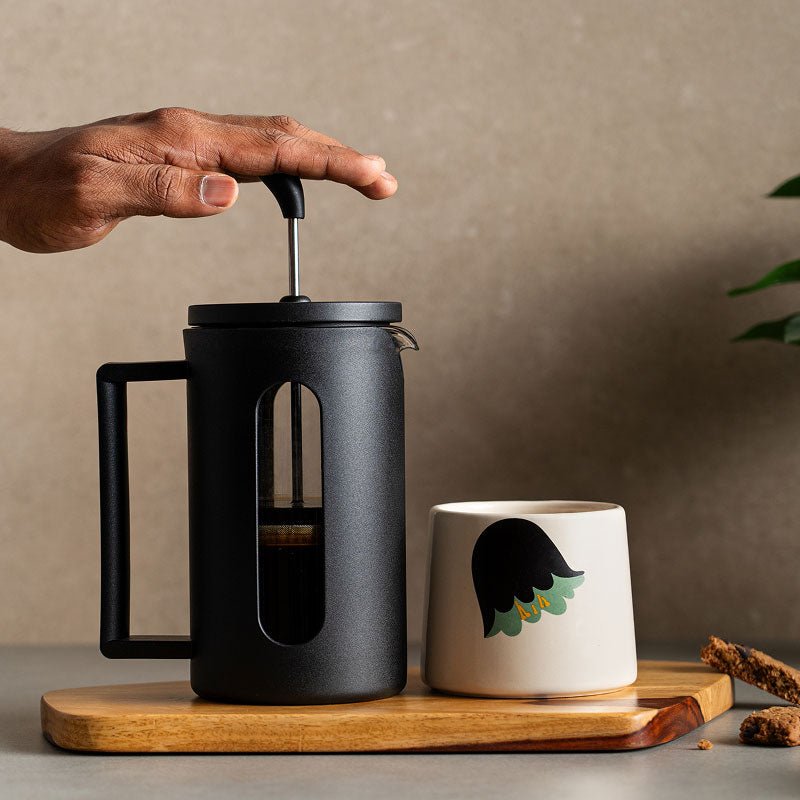
If an evening cup is part of how you wind down rather than how you stay awake, build it around that. A decaf brewed in a French press takes four unhurried minutes, fills the kitchen with the smell of coffee and costs you nothing at 2 am. The ritual was always the point.
Chicory based coffee is worth knowing about too, since it is naturally caffeine free and has been part of South Indian coffee for generations. A decoction made with a high chicory blend gives you the body and bitterness without the stimulant.