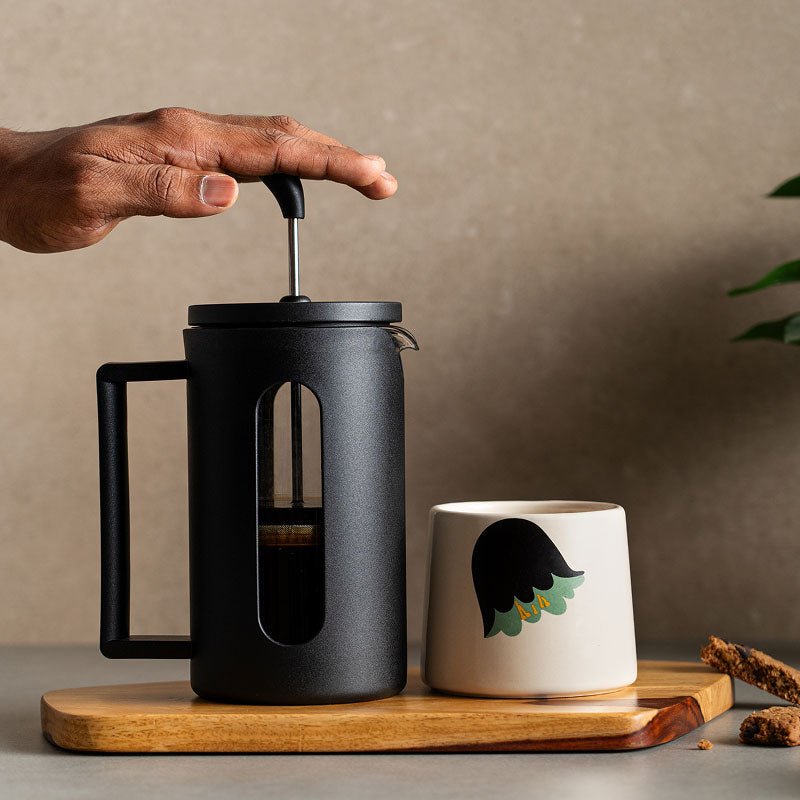
Coffee grinders split two different ways, and mixing them up is what makes buying one confusing. The first split is burr against blade, which decides grind quality. The second is manual against electric, which decides how the grinder fits your routine.
Get the first one right and almost any brewer improves. Get the second one right and you actually use the grinder every morning. They are separate decisions and both matter.
Burr or blade: the one that decides cup quality
Buy a burr grinder. A blade grinder chops beans into random fragments, while a burr grinder crushes them between two shaped surfaces to a set size, and that consistency is what makes extraction even.
The reason matters more than the rule. When particle sizes vary wildly, the small pieces over extract and turn bitter while the large ones under extract and taste sour. Both flavours land in the same cup, which is why blade ground coffee often tastes harsh and flat at once no matter how good the beans were.
Burr grinders also let you actually set a grind size. Coarse for French press, medium for filter, fine for espresso, repeatable every time. With a blade grinder the only variable is how long you hold the button, which is guesswork rather than control. Every grinder in the coffee grinders range works this way.
Burrs come in two shapes. Conical burrs are common in home grinders, run cooler and slower, and handle oily beans well. Flat burrs are typical in commercial machines and produce a slightly more uniform particle size, which matters most for espresso.
Manual or electric: the one that decides your routine
Both crush beans the same way. The difference is speed, portability and price, not grind quality, provided both use burrs.
Manual grinders have been around since the seventeenth century and work by hand. You add the beans, turn the crank, and mechanical force does the rest. Electric grinders arrived in the twentieth century and do the same job at the press of a button.
|
Manual grinder |
Electric grinder |
|
|
Time per dose |
1 to 3 minutes of cranking |
A few seconds |
|
Effort |
Physical, noticeable for espresso doses |
None |
|
Power needed |
None, works anywhere |
Mains socket |
|
Portability |
Light and compact, travels easily |
Bulky, stays on the counter |
|
Grind adjustment |
Stepped or stepless, precise on good models |
Usually dial based, fast to change |
|
Noise |
Almost silent |
Loud |
|
Price |
Lower for equivalent burr quality |
Higher |
One correction worth making, because it is a common misconception. Manual does not mean less precise. Grind consistency comes from burr quality, not from the power source, and a well made hand grinder will out perform a cheap electric one comfortably. What electric buys you is speed and ease, not automatically a better grind.
Where the effort actually shows up is dose size and grind fineness. Grinding 15g coarse for a French press by hand takes under a minute and is pleasant. Grinding 18g fine for espresso takes real force, and that is the point where most people move to electric.
Choose a manual grinder if
- You want a slower, more deliberate brewing ritual rather than a button press.
- Your budget is modest and you would rather spend it on burr quality than on a motor.
- You travel, camp or want coffee at the office without carrying a machine.
- You brew one or two cups at a time and mostly at coarser settings.
A hand grinder is also the sensible first grinder for anyone moving off pre ground coffee, since whole beans hold their oils and aromatic compounds far better than anything ground weeks ago.
Choose an electric grinder if
- You want ground coffee in seconds on a weekday morning.
- You brew espresso, where fine grinding by hand becomes hard work.
- You make coffee for more than one or two people regularly.
- You want to change grind settings quickly across different brew methods.
An electric grinder suits most household kitchens, and if you are grinding for a cafe or a high volume setting, commercial grinders are a separate category again, built for continuous use rather than a few doses a day.
How much should you spend
Enough to get burrs. A cheap burr grinder beats an expensive blade grinder every time, and the jump from blade to burr is larger than any later upgrade you will make.
Beyond that, spend according to what you brew. Filter and immersion methods are forgiving, so a mid range grinder is plenty. Espresso is not forgiving at all, and it needs finer adjustment steps and better burr alignment, which is where the price climbs.
Whichever you choose, buy the grinder before you upgrade the brewer. Freshly and evenly ground coffee beans in a modest brewer beat stale, unevenly ground coffee in an expensive one, and it is the single change most people notice immediately.