Irish coffee is hot black coffee, Irish whiskey, sugar and a layer of lightly whipped cream floated on top so it never mixes in. You drink it through the cream rather than stirring it, which is the entire point of the drink.
The specification is fixed and worth respecting, because almost every bad Irish coffee comes from ignoring one part of it.
|
Element |
Amount |
Why it matters |
|
Hot black coffee |
120 ml |
Strong enough to stand up to spirit and sugar |
|
Irish whiskey |
45 ml, a single measure |
Any more and it stops being coffee |
|
Brown sugar |
1 to 2 teaspoons |
Structural, not just sweetening |
|
Cream |
30 ml, lightly whipped |
Must float, never stirred in |
|
Glass |
180 to 200 ml, stemmed |
Handles heat and shows the layers |
The sugar is not optional
This is the part people skip and then wonder why the cream sinks.
Sugar raises the density of the coffee below, which is what allows a lighter cream to sit on top of it. Take the sugar out and the two liquids are close enough in density that the cream drops straight through. If you want a less sweet drink, reduce it to one teaspoon rather than removing it entirely.
Brown sugar is traditional and dissolves into something with a bit of caramel depth. Demerara works well too. Whichever you use, it has to be fully dissolved before the cream goes anywhere near the glass.
Where it came from
The drink was created in the winter of 1943 at Foynes, a flying boat terminal in County Limerick, by a chef named Joe Sheridan. A transatlantic flight turned back in bad weather and he made something to warm the passengers up. When one of them asked whether it was Brazilian coffee, he is supposed to have replied that it was Irish coffee.
It reached America through a travel writer named Stanton Delaplane, who brought it to the Buena Vista Cafe in San Francisco in 1952. They spent months working out how to float the cream reliably and now serve thousands a day.
Making it
1. Warm the glass. Fill it with boiling water, leave it for a minute, then tip it out. A cold glass drops the temperature of the drink by several degrees and makes the cream far more likely to sink.
2. Whip the cream to the right stage. This is the step that decides everything. You want it thickened but still pourable, at the point where it just holds a faint trail from the whisk and would still flow off a spoon. Fully whipped cream sits in a lump and will not spread. Unwhipped cream sinks. Ten to fifteen seconds of hand whisking is usually enough.
3. Add sugar and whiskey to the warm glass.
4. Pour in the hot coffee and stir until the sugar has completely dissolved. Leave about two centimetres of space at the top.
5. Float the cream. Pour it slowly over the back of a warm spoon held just above the surface of the coffee. Go gently and stop when you have a layer roughly a centimetre thick.
6. Serve without a spoon or a straw. The drink is meant to be sipped through the cream, so the cold cream and hot sweet coffee arrive together. Stirring it ruins the contrast completely.
Choosing the whiskey
Irish whiskey is triple distilled and generally smoother and lighter than Scotch, which is why it suits this drink. Something in the blended category is the sensible choice, since the coffee and sugar will flatten out the nuance of anything expensive.
What to look for is a whiskey with some sweetness and a soft finish. Heavily peated Scotch is the one to avoid outright, as the smoke fights the coffee rather than complementing it. Bourbon works if that is what you have, and gives a sweeter, rounder drink that is no longer strictly an Irish coffee.
Getting the coffee right
Brew it stronger than you would drink it on its own, because 45 ml of spirit and two teaspoons of sugar will bury a weak cup. A medium to dark roast with chocolate and nutty character holds up far better than a bright, fruity light roast, which loses everything under the whiskey.
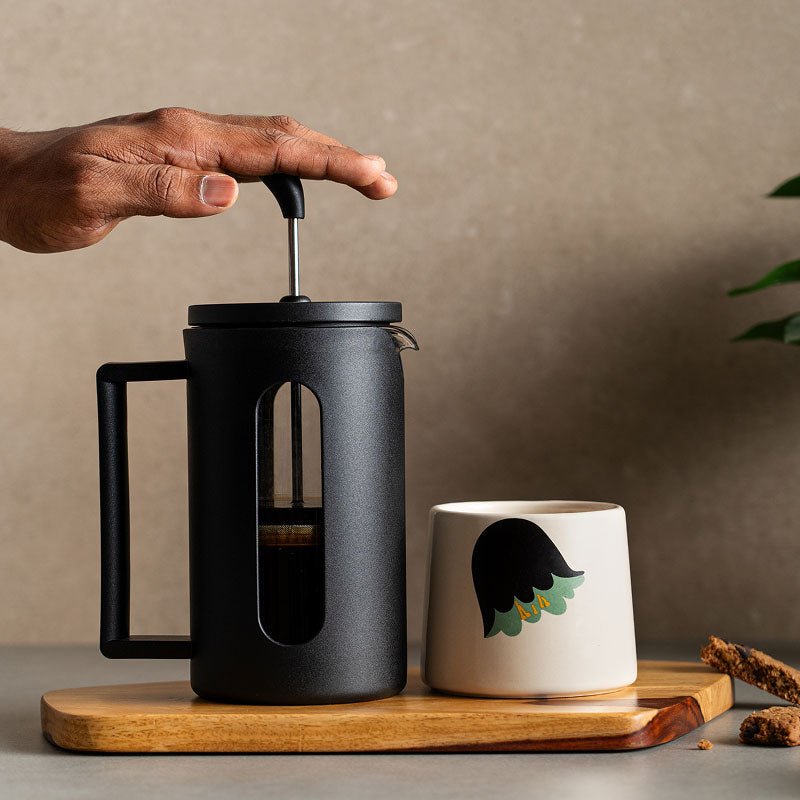
A French press is the practical choice here, since it produces the body the drink needs and makes enough for several glasses at once. The French press range covers sizes from single serve upward. A pour over works too if you brew it at a tighter ratio than usual.
Whatever method you use, freshly ground beans make a bigger difference than the whiskey does. A dark roast from the coffee bean range paired with a decent burr grinder will get you further than upgrading the spirit.
The glass
A stemmed, heat resistant glass of around 180 to 200 ml is the traditional vessel, and there are good reasons for it beyond appearance. The stem keeps your hand off the hot glass. The tapered shape supports the cream layer at the surface. And clear glass is the whole visual appeal, since a mug hides the layers entirely.
Ordinary glass tumblers can crack when hot liquid hits them, so borosilicate or tempered is worth using. The glassware range has pieces that work for this.
Variations
Baileys coffee. Replace the whiskey with 45 ml of Irish cream liqueur and cut the sugar entirely, since the liqueur is already sweet. It is a softer, more dessert like drink and considerably easier to make, because the cream float becomes optional.
Without cream. Perfectly acceptable, though it becomes a different drink. A hot whiskey coffee is fine on its own terms, and adding a splash of milk instead gives you something closer to a spiked latte.
Other hot alcoholic coffee drinks. Spanish coffee uses rum and triple sec with a sugared rim. Mexican coffee uses coffee liqueur and tequila. Italian caffè corretto is just espresso with a splash of grappa or sambuca and no cream at all.
Irish coffee vs espresso martini
They get compared constantly and they are close to opposites.
An Irish coffee is hot, sweetened with sugar, built on brewed coffee and whiskey, and topped with unmixed cream. An espresso martini is cold, shaken, built on espresso, vodka and coffee liqueur, and finished with a foam that comes from the shaking rather than added dairy. One is a winter drink meant to warm you, the other is a cold, sharp drink meant to wake you up.
Where it goes wrong
The cream sinks. Either the cream was not whipped enough, or the sugar was reduced or left out. Both are required.
The cream sits in a solid lump. Overwhipped. Stop while it is still pourable.
The drink is lukewarm. The glass was not preheated, or the cream was straight from the fridge. Let the cream sit out for ten minutes first.
Too boozy. A single 45 ml measure is the standard. Doubling it makes a hot whiskey with a coffee note.
Undrinkably sweet. Reduce to one teaspoon. Some coffees need less sugar than others to hold the cream.