When it comes to brewing a great cup of coffee at home, three variables matter most: brew ratio, water temperature, and grind size. Of the three, grind size is the one that home brewers most commonly get wrong, and the one that makes the most immediate difference to what ends up in the cup. This guide will walk you through why grind size matters, what each size looks like in practice, and which grind to use for every common brewer.
Understanding Coffee Grind Sizes and Why They Matter
Coffee is ground to increase the surface area of the roasted beans exposed to water. The more surface area in contact with water, the more coffee oils and flavours are extracted during brewing. Grind size directly controls this: a finer grind creates more surface area and faster extraction, while a coarser grind reduces surface area and slows extraction down.
Getting this balance right is the difference between a well-extracted cup and a bad one. If the grind is too fine for your brewing method, the coffee over-extracts and turns bitter, harsh, and astringent. If the grind is too coarse, it under-extracts and produces a sour, thin, watery cup with no body. The right grind size produces a balanced extraction where sweetness, acidity, and bitterness are in proportion to each other.
The two variables that guide grind size selection are contact time (how long the water is in contact with the coffee) and flow rate (how quickly water passes through the grounds). Longer contact time needs a coarser grind to slow extraction. Faster flow rate needs a finer grind to increase extraction. Every brewing method sits at a different point on this scale, which is why each requires its own grind size.
For consistent, uniform grounds across all these sizes, a burr grinder is essential. Blade grinders chop beans unevenly, producing a mix of fine dust and coarse chunks in the same batch, which leads to simultaneous over and under-extraction in the same cup. An electric coffee grinder with adjustable burr settings gives you the repeatability needed to dial in each brewing method accurately.
Grind Sizes for Common Coffee Brewers
French Press
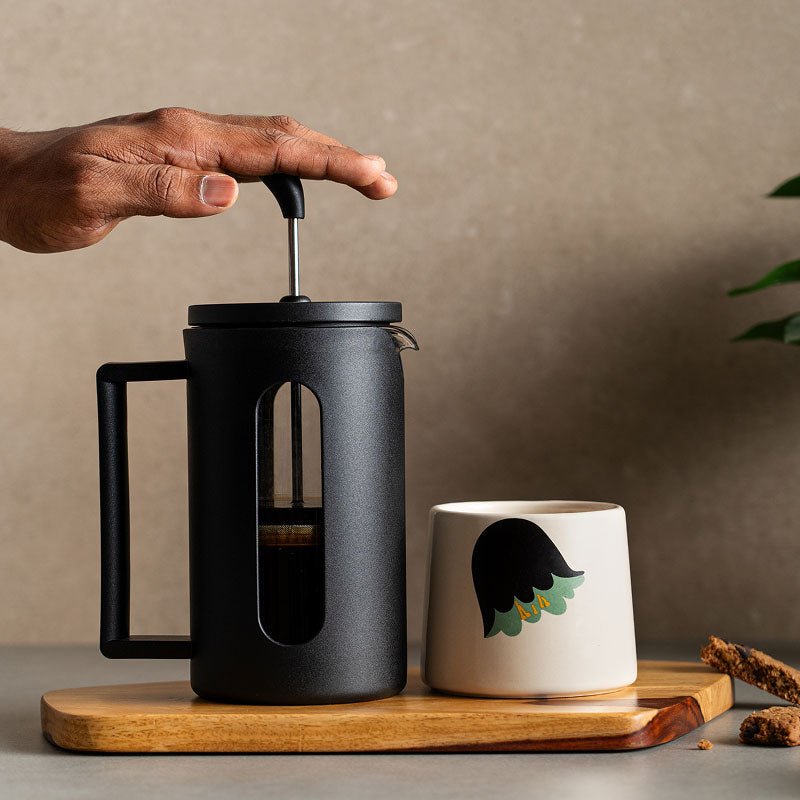
The French Press brews via immersion, meaning the coffee grounds steep directly in hot water for the entire brew time of around 4 minutes. Because the contact time is long and there is no pressure involved, a coarse grind is necessary to prevent over-extraction during the extended steep.
A coarse grind has a rough, chunky texture similar to sea salt or coarse sugar. It is the largest grind size used in common home brewing. Using a finer grind in a French Press results in bitter, muddy coffee and clogged mesh filters. The coarse grind also allows the metal mesh plunger to press down cleanly without resistance.
Pour Over
Pour Over brewing uses the infusion method, where water is poured slowly over the coffee grounds and drips through a filter into the cup below. The standard brew time is 3 to 4 minutes and the flow rate is controlled by the pour speed and the filter.
A medium-coarse grind works well for most pour over brewers. The texture is smoother and finer than a French Press grind but not as uniform as a drip grind. However, different pour over brewers require slight adjustments:
The Chemex uses a thick paper filter that slows the flow rate considerably, so a medium-coarse grind prevents over-extraction during the slower drip. The Hario V60 has spiral ridges that create a faster drain rate, which means a slightly finer medium grind is needed to slow flow enough for proper extraction. The Espro Bloom brews in under 3 minutes with a faster pour, so medium-coarse works well there too.
AeroPress
The AeroPress brews via a combination of immersion and pressure. The brew time is short, typically 1 to 2 minutes, and the plunger creates pressure to push the water through the coffee bed quickly. A medium-fine grind is ideal for AeroPress because the faster brewing time needs more surface area to extract sufficient flavour in less time.
The texture sits finer than sand but noticeably coarser than espresso. A medium-fine grind also prevents drip-through while the coffee is steeping before pressing and makes it physically easier to press the plunger through without excessive resistance.
Moka Pot
The Moka Pot, like the AeroPress, brews under pressure. Water in the sealed lower chamber is heated until steam pressure forces it upward through a basket of coffee into the upper collection chamber. The contact time is short and the pressure is high, which calls for a fine to medium-fine grind.
The texture is similar to fine table salt, slightly coarser than a dedicated espresso grind but significantly finer than a pour over grind. Using too coarse a grind in a Moka Pot produces a weak, under-extracted brew. Using too fine a grind can block the filter and produce over-extracted, bitter coffee.
Syphon Brewer
Syphon coffee brewers use a cloth or metal filter and brew via a combination of immersion and vacuum. The filter is finer than a French Press mesh but less restrictive than a paper filter. A medium grind is the right choice here: fine enough to extract properly during the brew cycle but coarse enough not to clog the filter or produce sediment in the final cup. Too fine a grind blocks the syphon filter; too coarse produces a weak, hollow-tasting brew.
Cold Brew
Cold brew is brewed via immersion in cold or room temperature water over 18 to 24 hours. The extremely long contact time means the grind must be coarse to prevent catastrophic over-extraction that would result in an intensely bitter, harsh concentrate. A coarse grind similar to or slightly coarser than a French Press grind produces a smooth, balanced, naturally sweet cold brew. The longer the steep time, the more important it is to use a very coarse grind.
Espresso Machine
Espresso extraction happens in 25 to 30 seconds under 9 bar of pressure. The extremely short contact time requires a fine grind to provide enough resistance to slow water flow and ensure sufficient extraction in that window. The texture is close to fine table salt or slightly finer, depending on the machine and the dose.
Even small adjustments in grind fineness have a significant impact on espresso. Half a step finer on a burr grinder can add several seconds to the extraction time and noticeably change the flavour. Finer grinds are also easier to tamp evenly into the portafilter, which ensures consistent resistance across the coffee bed. For espresso specifically, a dedicated hand grinder or electric burr grinder with step-less adjustment gives you the precision needed to dial in and repeat the ideal shot.
The Rule of Thumb for Choosing Grind Size
When you cannot find a specific guide for your brewer, two principles always apply. Choose a coarser grind when the coffee is in contact with water for longer. Choose a finer grind when the brew time is shorter or pressure is involved. The filter type also matters: metal mesh filters with wider openings need coarser grinds to avoid sediment passing through, while paper filters can handle finer grinds because they trap fine particles.
Closing Lines
Grind size is not a fixed rule but a starting point. Every roaster, every bean origin, and every grinder interprets grind settings slightly differently, which is why the best approach is to purchase whole beans and grind fresh immediately before each brew. Fresh grinding preserves the aromatic compounds in the beans and gives you the most consistent results across all brewing methods.
Start with the recommended size for your brewer, taste the result, and adjust one step at a time until the cup is balanced. That process of tasting, adjusting, and dialling in is how every grind setting gets perfected, and it is one of the most rewarding parts of home brewing.