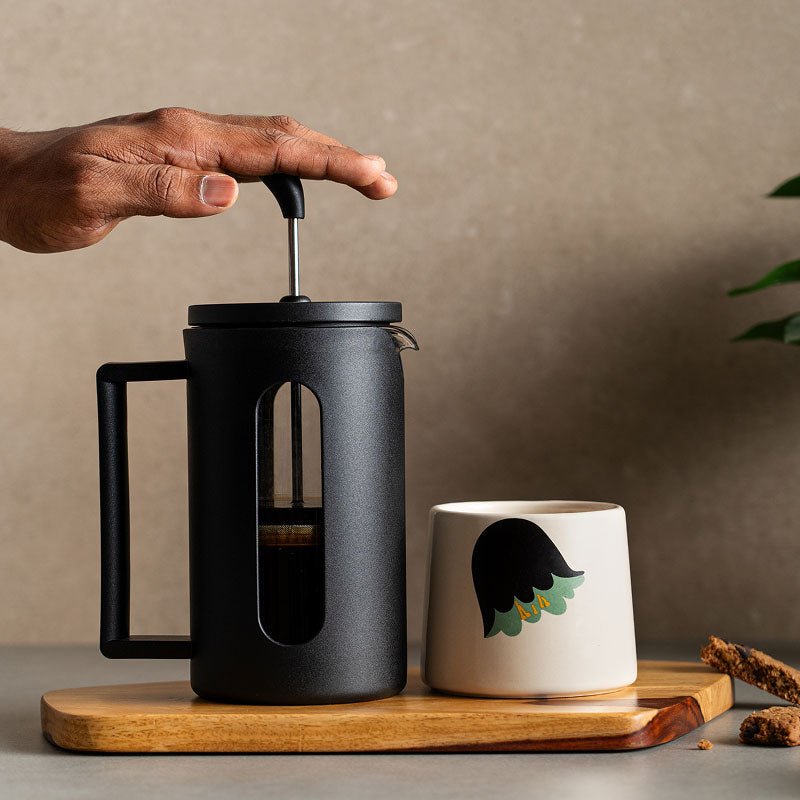
South Indian filter coffee is made in two stages. First you brew a thick concentrate called decoction by letting hot water percolate slowly through finely ground coffee in a stainless steel filter. Then you mix that decoction with hot milk and sugar, and pour it back and forth between a tumbler and a dabarah until it froths.
The whole thing takes about 25 minutes, most of which is waiting. What separates a good cup from a mediocre one is not skill but patience, the right grind and the correct ratio of decoction to milk.
What makes it different from other coffee
Every other brewing method you are likely to use finishes in under five minutes. Filter coffee takes 20 to 30 for the decoction alone, because gravity is doing all the work with no pressure and no stirring behind it.
That long, slow percolation through a very fine grind is what produces the strength. The result is closer to a concentrate than a brewed cup, dark enough that a quarter cup of it can carry a full tumbler of milk without disappearing. This is also why the drink survives being mixed with milk in a way that most filter coffees do not.
The names cause some confusion. Madras filter coffee, filter kaapi and degree coffee all describe the same drink. Degree coffee is the older term, generally understood to refer to the first and strongest decoction, or to coffee made with pure milk that had been tested with a lactometer for adulteration.
The filter itself
A traditional Indian coffee filter comes in four parts, and each one has a job.
- The upper chamber, with a perforated base, holds the coffee grounds
- The pressing disc, a small plate with a stem, sits on top of the grounds to compact them
- The lower chamber collects the decoction as it drips through
- The lid, which keeps the heat in during percolation
Sizes are usually described by how many cups they serve. A filter rated for four to six servings suits most households and gives you enough room to get the coffee bed depth right, which a very small filter does not.
Choosing the coffee
This is where most home attempts go wrong before brewing even starts.
The traditional blend is dark roasted with chicory added, usually somewhere between 10 and 30 percent. Chicory is not filler. It thickens the decoction, adds a bittersweet depth and slows the drip rate, which is part of why traditional filter coffee tastes the way it does. A blend at 80:20 coffee to chicory is the common middle ground. Pure coffee with no chicory makes a cleaner, brighter decoction that many people prefer, but it will taste noticeably thinner than what you get at a Bengaluru darshini.
Robusta plays a bigger role here than in most specialty brewing. It brings body, a heavier crema and considerably more caffeine, which is exactly what you want in a drink that will be cut with milk. The full picture on that is in the guide to robusta coffee beans. Most traditional blends lean robusta or mix it with arabica.
Grind matters just as much. You want fine, close to table salt but not powdery. Too coarse and the water runs straight through, leaving you with weak decoction. Too fine and it compacts into a plug that barely drips at all. Grinding fresh makes a real difference over a packet that has been open for weeks, so a burr coffee grinder is the single most useful thing to own if you drink this daily.
Beans grown in Chikmagalur, Coorg and the Nilgiris have historically supplied this style of coffee, and the coffee growing regions of India are worth understanding if you want to buy by origin rather than by brand.
Making the decoction
Add the coffee. Put 3 to 4 tablespoons of finely ground coffee into the upper chamber for a four cup filter. Spread it evenly across the base rather than leaving it mounded in the centre.
1.Press it down. Place the pressing disc on top and press firmly but not with all your weight. You want the bed compacted enough to slow the water, not sealed shut. This step controls your drip rate more than anything else.
2.Boil the water and wait. Bring water to a boil, then let it sit for 30 to 45 seconds. Water at a full rolling boil scorches the grounds and pulls out harsh bitterness. Around 92 to 95 degrees is the target, which a temperature controlled kettle makes trivial to hit.
3.Pour and cover. Fill the upper chamber almost to the top, put the lid on and leave it alone. Do not lift the lid to check, and do not shake or tap the filter to speed it up.
4.Wait 20 to 30 minutes. The decoction should drip steadily rather than run. When the upper chamber is empty, you are done. What sits in the lower chamber is your concentrate, dark and thick.
A well made decoction is almost black and coats the sides of the vessel slightly. If it looks like weak tea, the grind was too coarse or you did not use enough coffee.
Building the cup
1.Heat the milk until it is hot but not boiling. Full fat milk gives the best result. Traditionalists strain off the cream layer, though mixing it in is fine if you like a richer cup.
2.Pour the decoction into the tumbler, roughly a quarter of the final volume.
3.Add sugar while the decoction is still on its own, so it dissolves properly rather than sitting at the bottom.
4.Add the hot milk in a steady pour and stir once.
5.Pull the coffee. Pour it from the tumbler into the dabarah and back again, holding the containers apart as you go. Repeat four or five times.
That last step is not theatre. Pouring from a height aerates the coffee, mixes the milk and decoction thoroughly, and drops the temperature to something drinkable. It is also what creates the froth that a filter coffee is supposed to arrive with.
Getting the ratio right
|
Style |
Decoction |
Milk |
Result |
|
Standard kaapi |
1 part |
3 parts |
Balanced, the everyday cup |
|
Strong |
1 part |
2 parts |
Darker, closer to a cortado |
|
Light |
1 part |
4 parts |
Milky, suits weaker decoction |
|
Black decoction |
1 part |
None, hot water to taste |
Clean and intense |
Start at 1:3 and adjust once. Weighing rather than eyeballing removes most of the inconsistency between cups, and a coffee scale pays for itself quickly if you care about repeatability. The same principle applies to any brew method, which the fundamentals of brewing coffee at home covers in more depth.
When it goes wrong
The decoction is bitter. Water was too hot, or the coffee is over roasted. Let the kettle rest longer before pouring.
Nothing is dripping. You pressed the disc too hard or ground too fine. Loosen the bed slightly and go one step coarser next time.
It ran through in five minutes. The grind is too coarse for percolation. Go finer, and check you used enough coffee for the filter size.
There is no froth. Either the milk was not hot enough, or you did not pour from a sufficient height. Increase the gap between the vessels and add a couple more pours.